“everybody can run, only one can be first, but the last across the finish really is the one who wins the greatest prize,”

It was high school football night as I sat on the sidelines of a family friends game. Thought I’d try an experiment and just sit. Settled in to not wander. Figured I would simple see who came into view. Twenty minutes, thirty minutes, nothing pulled at me. Until in the middle of a wave of parents, players and coaches, I saw him. It was weird how for some unexplainable reason he stood out as I first put eyes on him, standing about forty yards downfield from where I was sitting.
Without hesitation he accepted the offer to share his wisdom as he fully opened his life to me. His name was John, Born in Croatian, age 79; he came right out of the gates telling me he was a Pancreatic Cancer survivor. My knees buckled. It was very personal, maybe even the reason I was attracted to approach him. You see, my father died in just six weeks after being diagnosed with the disease. And every since then, I’ve viewed the sickness as hopeless. A whole topic in itself, one that I am still dealing with in my lack of respect for many of the health care options available to senior citizens: Perhaps I’ll address my feelings on the matter in another story one day.
John healed part of me that day, and I hope for anyone in the midst of the disease who may be reading this essay, that maybe it can give you a little faith in the possibility of surviving Pancreatic Cancer.
John, Croatian name, Ivica Vukovic, credited his miraculous healing to a special tea and not to modern medicine (taheeboteaclub.com). After a very aggressive six-and-a-half hour procedure to remove the affected tissue around his Pancreas, the doctors gave him two months max. He lifted his shirt to show me a twelve-inch scar to prove it.

Telling me all options were off the table, except one, the special tea; known for its healing properties as he insisted it was the cure to his illness. Ignoring the doctor’s predictions, he promptly began drinking it. Thirteen years later, he was still here to watch his grandson play football.
This heavy accented glowing human being had pulled at my heartstrings. A man of great positivity, his energy was duly noted by the line of bi-passer’s who, as they walked by us while we were taking pictures, harassed: “Hey John, have him photograph me, I’m much more handsome than you. So, now you’re famous? Looking good John!”
We talked of his escape from Croatia during the Yugoslavian occupation. What a blemish in human history. In speaking of such a horrific account he did not even break a sweat, and I know he had seen things too dark for many to discuss. John just kept smiling and redirected by giving me advise on making my wife happy. But I could not let go of wanting to know more about his exit of Croatia.

How did you get out, I asked. “Simply,” he said, “with a gun and not a passport.” I paused to reflect as he took a breath of remembrance. Then resuming his story he described his path: Trains to a few stops within the boarders of Austria and Germany, then footpaths over the boarders (what he didn’t share was how heavily they were patrolled). He credited our German friends for their acceptance of he, his wife and six-year-old son.
Once in Germany, he was screened for one year and finally got papers to exit the country. It took that much time to confirm that he had no criminal background or any other unsavory past. I’m sure he had lost his gun by that time.
With papers in hand, he moved his family to Toronto Canada, thirteen years later to California. He claimed, “best place on earth to live, anywhere between Santa Barbara and San Diego, I’m a California Boy!”

In closing, I asked him if there were any thoughts he wished to share with the world.
In a humble tone he spoke of concern for his grandson, “I fear we are in store for another World War. Further quoting Mark [12:31]–“Love thy neighbor as thyself.”
Elaborating, “everybody can run, only one can be first, but the last across the finish really is the one who wins the greatest prize,” and lastly,“pray often for yourself, your family and your country.”
In what I quickly realized was signature John style he shared his final wisdom, something that perhaps is scalable to all of our outlooks toward others of different origins. “Canadians are a lot like Americans.”
Talk tomorrow my good friends,
Richard
Readers, if you are returning, so nice to be with you again. If you are new, looking forward to getting to know you.
To all: please comment, like, and forward. Every engagement goes a long way toward connecting us; as together, we grow a movement that betters the way we view and treat one another.


 However, credit where credit is due. Marie came from a line of artists. Here mother Janet was an accomplished pastel artist. We talked about art for a minute and then they invited me into their home to see some of her drawings. We even figured out an on-the-fly way to photograph one of them. I would be remise if I did not show you her artwork. It went further though—Janet also has a son following in her artistic footsteps, a very successfully working celebrity photographer. Both she and Marie told me about him with great pride. I always love it when I hear of other people staying alive as photographers and artists. I was thankful for their affirmation.

 But foremost as I got to know Nelson, and looking past his business acumen and gansta dreams, I saw the real man as we shared photos of our daughters. It only took a second to switch off the gears of everything else we were talking about. Shifting to a conversation about the importance of children being protected, educated and raised in a safe environment. Adding to that he suggested the importance of community supporting less privileged children—topics that highlighted the character and heart’s intent of Nelson, and a lesson in knowing that beneath every façade of what we see on the outside, might be a slightly fuller picture.
 September 24, 2011: I was directing a casting session and in doing so had the opportunity to meet 200 people. Not exactly like approaching strangers on the street. But I figured they were still strangers—people I was meeting for the first time. So I thought, technically speaking, that made them strangers.

 Either unaffected or not aware of the insult that was just thrown at him, he did not respond, just sat there, eating his popsicle. I couldn’t let it go. There was something interestingly peaceful about him, and I needed to know what it was.
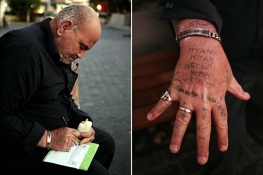 “I had a hard life, but I’m thankful for living.” You see, Mark was a recovering drug and alcohol abuser. “I have wasted most of my life, but I’m content with who I am now,” as he explained himself.


